 Spookyswap
 connects token swaps with liquidity provision, farming, and BOO staking
Spookyswap is a decentralized exchange where users trade tokens against liquidity pools and provide assets to earn swap fees. Its V3 design lets providers choose price ranges, so a position participates in trading only within its interval. The broader suite includes V3 farms, BOO and xBOO staking, a token launchpad, and perpetual trading. Network, pool version, and product choice determine the contracts involved and the relevant costs.
The short version: An out-of-range V3 position earns no new swap fees, even when other positions keep the same pool trading.
Token swaps through pooled liquidity
A spot swap exchanges an owned token for another token through the pool’s available liquidity. The automated market maker, or AMM, prices trades through its pool mechanics as trading changes the pool’s balances and relative price. Available liquidity influences how far that price moves during execution.
Market swaps
Market swaps use the liquidity available when the transaction executes. Price impact describes the movement the trade itself causes. Slippage concerns changes between quoting and execution; the minimum-output condition limits the output reduction a swap accepts. A displayed quote isn’t a completed trade, and execution can fail when its conditions no longer hold.
Range orders
V3 range orders use concentrated liquidity to exchange assets as trading passes through a selected price interval. The position can earn fees during that conversion, which supports selling above the current price or buying below it. This liquidity-based mechanism doesn’t provide a general stop-loss order. The conversion can reverse if liquidity remains in place when the price retraces the interval.
The V2 and V3 liquidity models
V2 distributes liquidity across the price curve, while V3 lets providers allocate assets within selected intervals. Concentrating funds can create more trading depth around a chosen price with the same capital. Core V3 positions use non-fungible tokens, or NFTs, to represent individual ranges and liquidity, including when a provider chooses the full range. The swap interface supports liquidity from both versions, although token compatibility can differ when a token changes transfer amounts. V3 pools also store historical price and liquidity observations for oracle use.
How much does a swap cost?
The pool fee and the network transaction fee form distinct parts of a spot swap’s cost. The published V3 pool fee tiers are 0.01%, 0.05%, 0.30%, and 1.00%. Governance can introduce additional tiers, so the applicable pool determines the trading fee; a protocol-fee setting can direct part of collected fees to the protocol.
A lower fee tier doesn’t necessarily deliver more output. Liquidity depth and price impact also affect the exchange rate for the selected amount. Compare the quoted output alongside the wallet’s gas estimate. Network gas pays for transaction execution and varies independently of the pool tier; token approvals can also incur their own transaction costs.
Price ranges control V3 fee participation
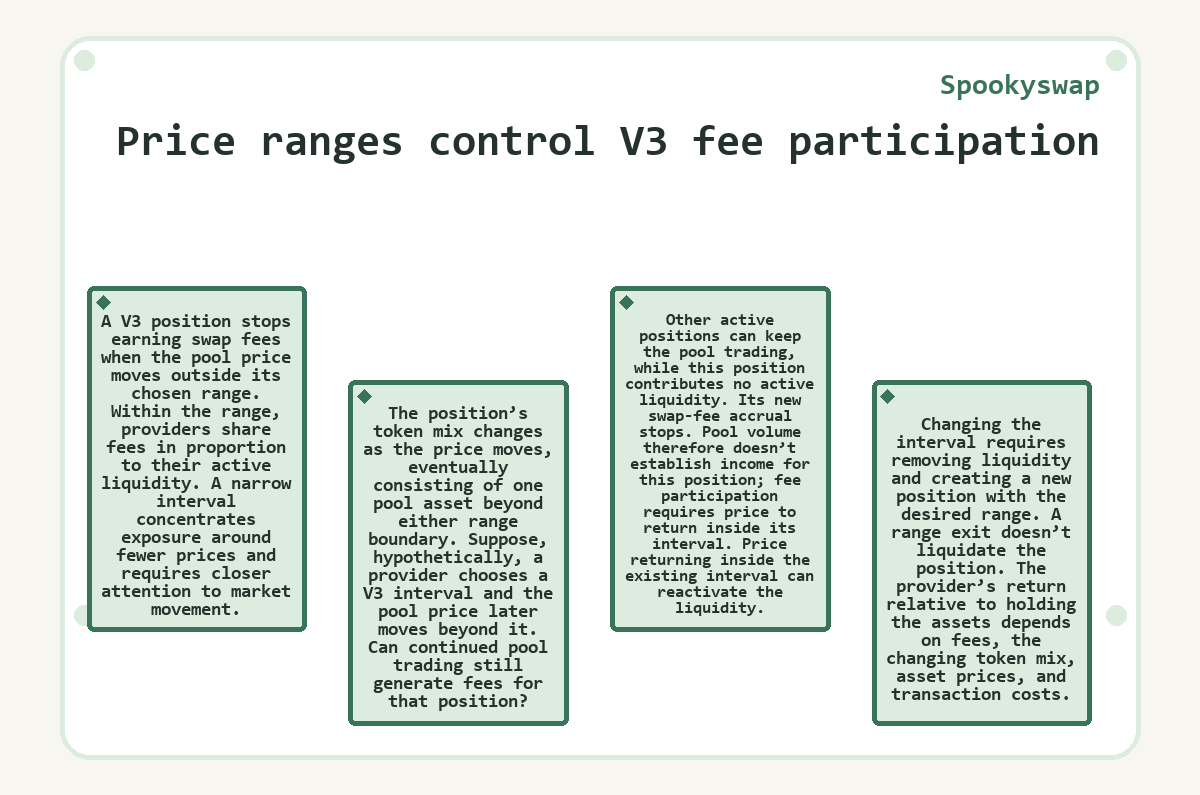
A V3 position stops earning swap fees when the pool price moves outside its chosen range. Within the range, providers share fees in proportion to their active liquidity. A narrow interval concentrates exposure around fewer prices and requires closer attention to market movement.
The position’s token mix changes as the price moves, eventually consisting of one pool asset beyond either range boundary.
Suppose, hypothetically, a provider chooses a V3 interval and the pool price later moves beyond it. Can continued pool trading still generate fees for that position? Other active positions can keep the pool trading, while this position contributes no active liquidity. Its new swap-fee accrual stops. Pool volume therefore doesn’t establish income for this position; fee participation requires price to return inside its interval.
Price returning inside the existing interval can reactivate the liquidity. Changing the interval requires removing liquidity and creating a new position with the desired range. A range exit doesn’t liquidate the position. The provider’s return relative to holding the assets depends on fees, the changing token mix, asset prices, and transaction costs.
Sonic deployment and the Fantom migration
Sonic has its own exchange contracts and pools, separate from the earlier Fantom Opera deployment. The project’s history also includes V3 deployments on Horizen EON and BitTorrent Chain. An identical token ticker across networks doesn’t make the balances or pool liquidity interchangeable. Network selection determines which deployment a wallet accesses.
On Sonic mainnet, chain ID 146 identifies the network, and native S pays transaction fees. BOO is the exchange’s utility token. Wrapped S is a token used in pools; it doesn’t directly replace native S for gas. Wallet connection options include MetaMask and other browser wallets, WalletConnect, and Coinbase Wallet.
The historical BOO migration began on December 26, 2024, as a one-way, 1:1 conversion from Fantom Opera to Sonic. Its published four-month window has passed. That migration offer had a time limit; selecting Sonic in a wallet doesn’t itself move an existing Fantom balance.
BOO governance and xBOO staking
BOO supports protocol governance and buyback staking, with xBOO recording a share of the staking pool.
Community voting
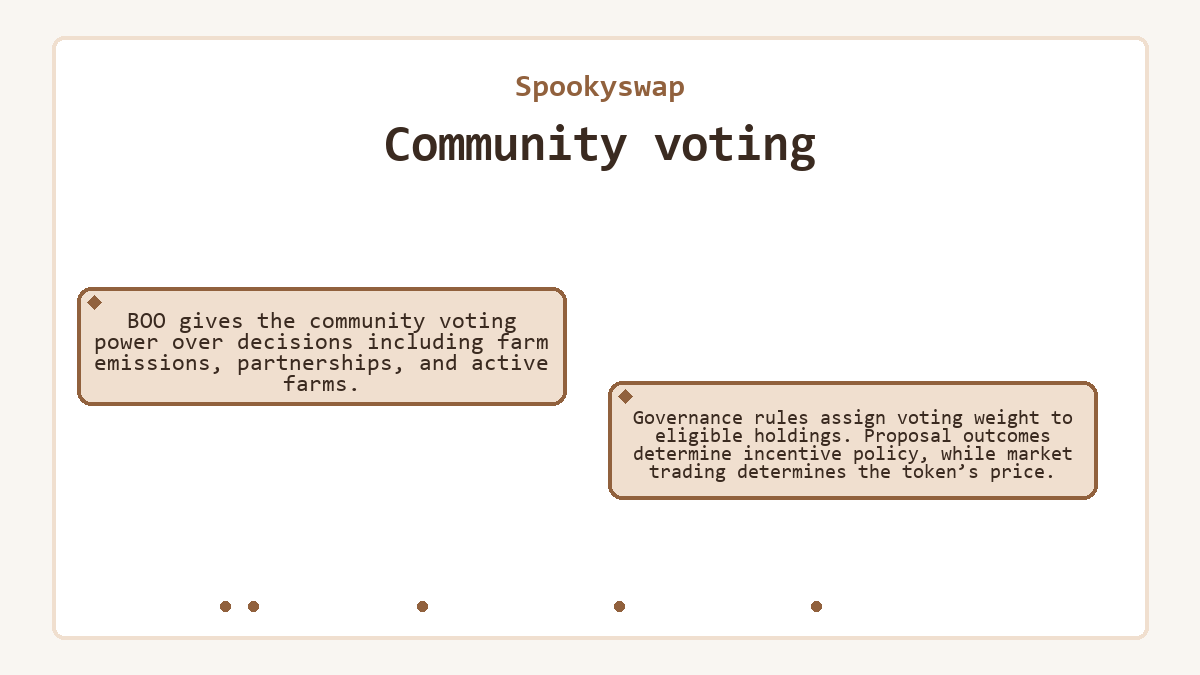
BOO gives the community voting power over decisions including farm emissions, partnerships, and active farms. Governance rules assign voting weight to eligible holdings. Proposal outcomes determine incentive policy, while market trading determines the token’s price.
Buyback staking
Depositing BOO into the buyback pool returns xBOO representing a proportional share of that pool. The pool uses a portion of trading fees to buy BOO. Those purchases can increase the BOO backing each receipt while the holder’s xBOO count stays unchanged. Redemption follows the pool’s ratio.
Available partner pools can accept xBOO and distribute separate reward tokens. Their incentives have their own terms. A quoted staking rate describes a variable return, and it doesn’t establish a fixed future BOO balance or market value.
Farms add incentives to eligible positions
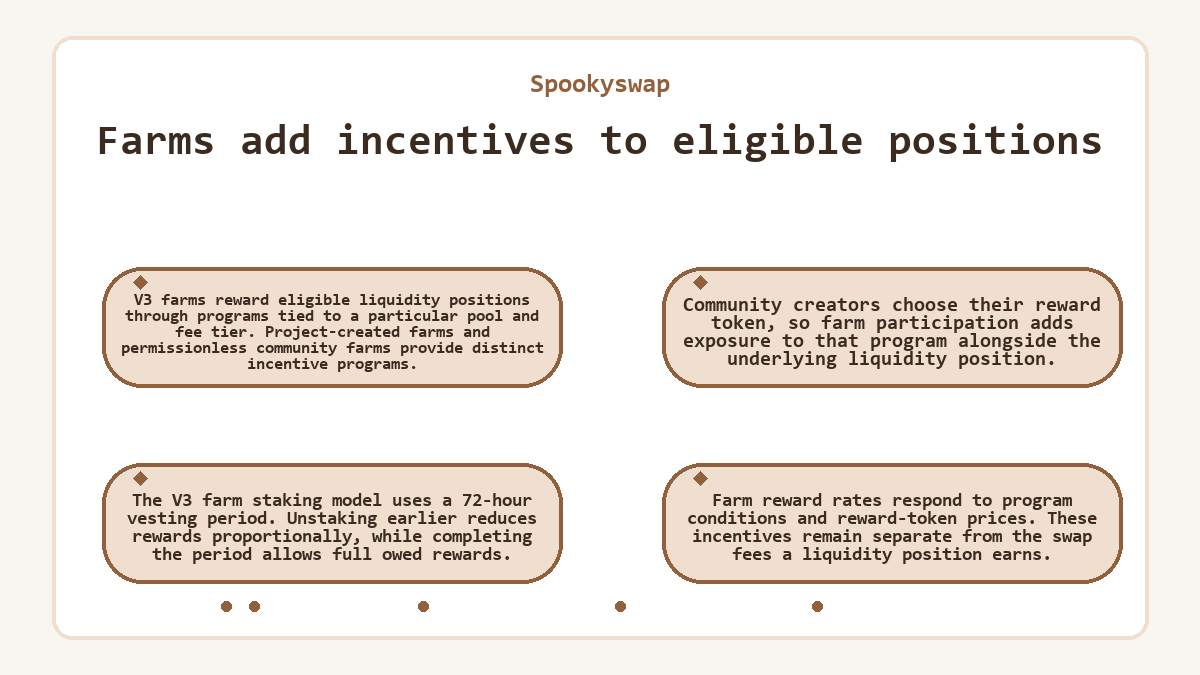
V3 farms reward eligible liquidity positions through programs tied to a particular pool and fee tier. Project-created farms and permissionless community farms provide distinct incentive programs. Community creators choose their reward token, so farm participation adds exposure to that program alongside the underlying liquidity position.
The V3 farm staking model uses a 72-hour vesting period. Unstaking earlier reduces rewards proportionally, while completing the period allows full owed rewards. Farm reward rates respond to program conditions and reward-token prices. These incentives remain separate from the swap fees a liquidity position earns.
Launchpad tokens, bridging, and perpetual markets
The wider suite adds token launches and derivatives, while bridging serves a separate cross-network transfer task. Magicats is the project’s collectible NFT series, distinct from NFTs representing liquidity positions.
Token launches
The permissionless Launchpad trades new tokens through a linear bonding curve before deploying pool liquidity. Its contract holds inventory and quotes buys and sells along that curve. Reaching the configured market-capitalization threshold triggers liquidity deployment using inventory and proceeds. Early trading prices and later pool prices follow different market mechanisms; a listing doesn’t establish a token’s value.
Bridging access
Bridge access concerns moving assets between blockchains. Transfer mechanisms, supported tokens, route availability, and destination fees depend on the selected bridge. These conditions differ from exchanging tokens within one chain’s liquidity pools. A swap’s pool fee doesn’t describe the total cost or completion time of a cross-network transfer.
Perpetual positions
Spooky Perps supports long and short derivative positions through an account with USDT collateral. Its cross-margin model shares collateral across positions, allowing unrealized gains and losses to offset. The contracts have no expiry; closing a position settles gains or losses from entry and exit prices. Leveraged positions face liquidation risk, so their collateral exposure differs from owning tokens after a spot swap.
Useful questions about Spookyswap
Can a token’s transfer tax prevent a V3 swap?
V3’s standard routers don’t support fee-on-transfer tokens. A transfer tax changes how many tokens the receiving contract obtains, which conflicts with the router’s accounting. Token creators can develop a wrapper or customized router, but support depends on that implementation. Increasing slippage tolerance doesn’t add compatibility to the standard V3 router.
How do rebasing tokens affect V3 liquidity?
A negative rebase can cause a loss for V3 liquidity providers when their position becomes active. Rebasing tokens can support pool creation and swaps, so successful trading doesn’t eliminate this liquidity risk. The balance adjustment follows the token’s rules, and the V3 position mechanism doesn’t recover the negative-rebase loss.
Does V3 automatically reinvest my position’s swap fees?
Core V3 positions accrue collectable swap fees without automatically reinvesting them. Removing a position collects its accrued fees alongside the withdrawn liquidity. Any separate strategy offering reinvestment adds its own mechanism and conditions; that behavior doesn’t follow simply from holding a V3 position NFT.
Who can submit BOO governance proposals?
Anyone can create governance proposals through Snapshot. Submission and voting are different parts of governance: the ability to propose a change doesn’t provide enough voting power to pass it. BOO holdings and their eligible forms determine voting weight under the proposal’s voting rules.
Can one V3 position participate in several farms?
One V3 position can participate in multiple compatible farms for its pool. Each farm has its own reward program, so simultaneous participation doesn’t merge their terms. Withdrawing the position requires unstaking it from every farm first. A remaining stake in another farm can keep withdrawal unavailable, including when that farm is inactive.
Are Magicats still available from the original mint?
The original Magicats mint has ended. The existing collection contains 5,000 NFTs, including thirteen entirely unique cats. Acquiring an existing collectible differs from minting a new one. Creating a V3 liquidity position issues a position NFT, which belongs to a different system and doesn’t mint a Magicat.
Is a missing token in the selector evidence that my wallet has lost it?
A token’s absence from the selector doesn’t establish a loss of the wallet’s on-chain balance. The interface allows token lookup by contract address and manual addition. The address must identify the intended token on the selected network. Adding it to a list doesn’t create liquidity or establish that its transfer behavior supports the selected pool version.
Does the V3 oracle always retain the same amount of price history?
A V3 oracle’s available history depends on the observations its pool retains. Each pool begins with a single observation, and participants can pay transaction fees to expand observation capacity. Integrations can derive time-weighted measurements from retained price and liquidity data. Storage configuration and accumulated observations determine the usable history, so a fixed lookback period doesn’t apply to every pool.