 Spookyswap
Spookyswap farming adds incentives to eligible V3 positions under reward vesting rules
Spookyswap farming adds incentive rewards to eligible V3 liquidity positions staked in active farms, with payouts depending on range activity and vesting. The position’s LP NFT must match the farm’s pool and fee tier. Farms using 72-hour reward vesting reduce payouts for early unstaking. Harvesting claims reward tokens, while withdrawing returns the LP NFT; these actions leave the underlying liquidity position intact.
Pool eligibility, reward vesting, and ownership of the deposited NFT govern different parts of farming. A position can qualify for incentives while its rewards remain partly unvested. It can also stop participating in a farm while the contract still holds its NFT.
The LP version and pool determine farm eligibility
A V3 farm accepts eligible position NFTs for its specified pool, including the pool’s fee tier. Matching token names alone doesn’t establish a match: different fee tiers identify different pools. Fantom Opera and Sonic also use separate deployment contracts. Selecting another network doesn’t move an existing position or its farm deposit between those deployments.
Earlier Fantom farms used fungible LP tokens. The 2022 Farm V2 upgrade changed the farming contract and supported additional reward tokens. Programs could add project-funded incentives alongside BOO rewards or operate independently of them. That migration required holders of staked V1 LP tokens to unstake from the older farm and restake in its replacement. It didn’t convert LP receipts into V3 position NFTs.
Within V3, Official Farms identify programs the protocol creates, while Community Farms identify user-created programs. Both target eligible liquidity positions, and the selected program determines its incentive token and schedule. BOO staking uses a separate xBOO receipt mechanism, so it isn’t a prerequisite for staking an eligible LP NFT.
Prepare and stake the eligible liquidity position
Preparation starts with the selected farm’s pool, fee tier, and network. Match these details before authorizing tokens or committing liquidity.
Set the pool and price range
V3 liquidity has a chosen price interval. A custom range concentrates liquidity within selected bounds; the Full option spreads it across the supported full range. The current pool price and chosen bounds determine the amounts the position requires. A narrower interval needs closer monitoring because price can leave it sooner. Farm eligibility and active participation in swaps answer different questions, so an eligible NFT doesn’t establish continuous trading-fee income.
Create the position and stake its NFT
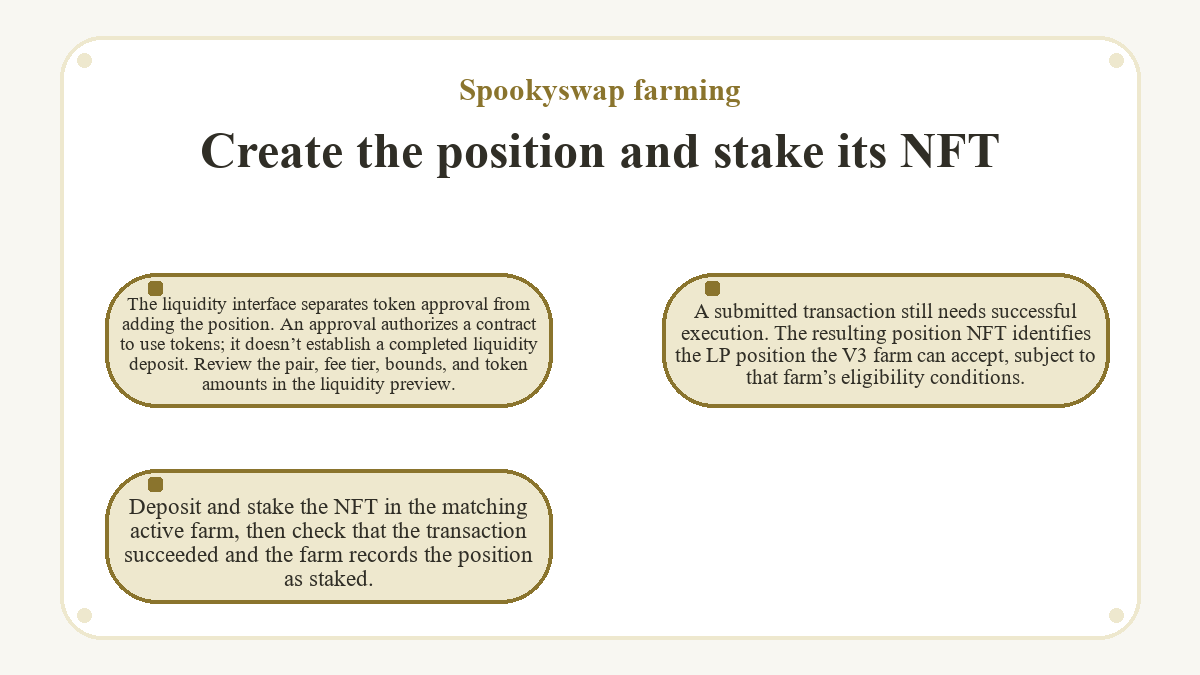
The liquidity interface separates token approval from adding the position. An approval authorizes a contract to use tokens; it doesn’t establish a completed liquidity deposit. Review the pair, fee tier, bounds, and token amounts in the liquidity preview. A submitted transaction still needs successful execution. The resulting position NFT identifies the LP position the V3 farm can accept, subject to that farm’s eligibility conditions. Deposit and stake the NFT in the matching active farm, then check that the transaction succeeded and the farm records the position as staked.
How do unstaking, harvesting, and withdrawing differ?
Unstaking ends participation in a selected farm, harvesting claims available incentive tokens, and withdrawing returns the deposited LP NFT. None of these actions removes the liquidity represented by that NFT.
Claim the incentive balance
In the V3 farming interface, rewards become harvestable after unstaking. Harvest sends the available reward balance to the wallet. The farm contract tracks reward claims separately from deposited positions, so a completed claim doesn’t establish that the LP NFT has returned. Vesting determines the payable reward balance when participation ends.
Release the deposited position
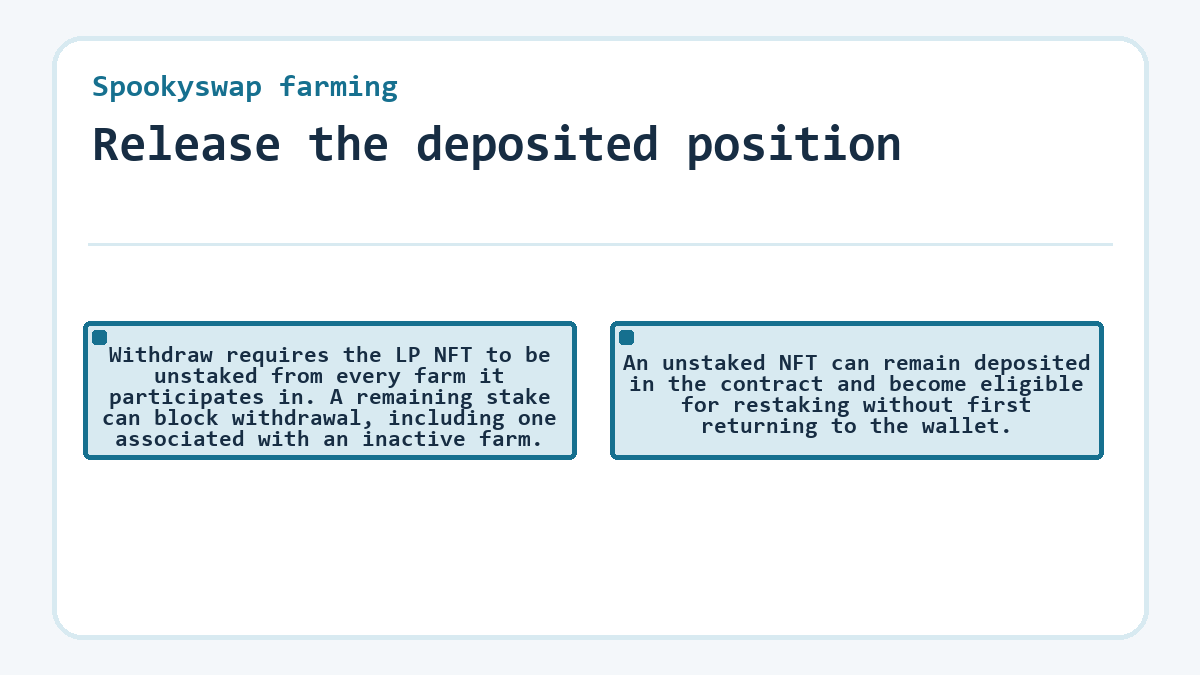
Withdraw requires the LP NFT to be unstaked from every farm it participates in. A remaining stake can block withdrawal, including one associated with an inactive farm. An unstaked NFT can remain deposited in the contract and become eligible for restaking without first returning to the wallet.
An additional farm changes the withdrawal outcome
Consider a hypothetical eligible LP NFT deposited in the farm contract and staked only in the selected farm. Assume its reward vesting requirement has completed. The objective is to receive the available rewards and return the same NFT to the wallet.
The deposit owner unstakes, harvests the available reward balance, and withdraws the NFT. Successful transaction records and the NFT’s on-chain owner provide separate checks for the reward claim and position return.
Now change only the remaining farm participation: assume the same NFT also stays staked in another farm. Harvesting the first farm’s available rewards doesn’t release that additional stake. Withdrawal remains unavailable until all farm stakes end. The other farm’s vesting conditions affect the reward cost of ending that participation.
How does vesting change the reward payout?
Vesting changes how much accrued reward an unstake makes payable. V3 farms using 72-hour vesting reduce rewards when a position unstakes before vesting completes. An early unstake remains possible under this rule; its consequence concerns reward entitlement.
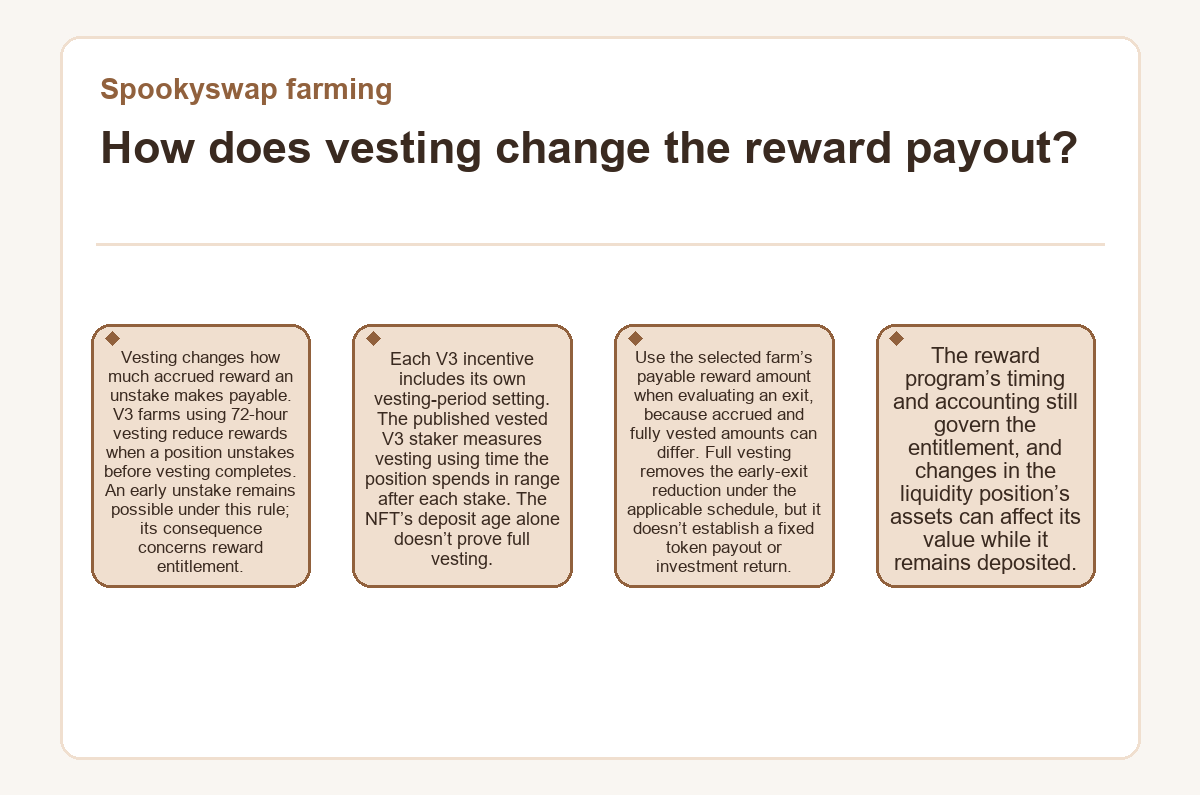
Each V3 incentive includes its own vesting-period setting. The published vested V3 staker measures vesting using time the position spends in range after each stake. The NFT’s deposit age alone doesn’t prove full vesting. Use the selected farm’s payable reward amount when evaluating an exit, because accrued and fully vested amounts can differ. Full vesting removes the early-exit reduction under the applicable schedule, but it doesn’t establish a fixed token payout or investment return. The reward program’s timing and accounting still govern the entitlement, and changes in the liquidity position’s assets can affect its value while it remains deposited.
Monitor the range and the value of rewards
A position outside its price interval stops earning swap fees until price returns inside that interval. The published vested V3 staker also uses the position’s in-range liquidity time to calculate farm rewards. Price movement also changes its token composition, potentially leaving it entirely in one asset at a boundary. Incentive tokens add a separate source of value; they don’t cancel the position’s exposure or impermanent loss. Keep the farm reward balance distinct from trading fees and the underlying assets. Network transaction costs reduce the net proceeds of claims and withdrawals. A later swap of harvested tokens introduces its own execution price and slippage considerations.
Community farms let pool sponsors choose incentives
Community farming lets a sponsor fund rewards for an existing V3 pool. It creates an incentive program without changing the pool’s underlying trading mechanics.
Define the reward program
The creation interface accepts a reward token, a total reward budget or daily reward amount, and start and end times. The sponsor selects the target LP pair and fee tier. Token approval authorizes reward funding. Successful execution of the farm-creation transaction funds and creates the incentive. Choosing a different incentive token changes what participants earn without changing the liquidity pool’s token pair.
Token restrictions and pool depth
The Riskier Farms filter includes pools with tokens outside the platform’s token list. Listing a community farm doesn’t establish the reward token’s quality or the pool’s ability to absorb trades. Some token contracts restrict selling, and low liquidity can make exits costly.
Frequently asked questions about Spookyswap farming
Can I deposit several LP NFTs in the same V3 farm?
A single V3 farm can accept multiple eligible LP positions. Each NFT must correspond to the qualifying pool, including its fee tier, on the selected network. Separate NFTs can represent different price ranges within that pool. Depositing several positions doesn’t merge their underlying liquidity into one interchangeable receipt, so keep each position identifier distinct.
Does an older V2 LP position enter V3 farming automatically?
An older V2 LP receipt doesn’t automatically become a farmed V3 position. Liquidity migration removes the V2 liquidity and creates a V3 position with a chosen fee tier and range. Token compatibility matters before migration. The resulting NFT must then qualify for the selected V3 farm; the older farming contract’s version label doesn’t establish that eligibility.
Is single-sided liquidity possible when preparing a position for farming?
V3 permits single-sided liquidity when the chosen price interval lies outside the current pool price. The position still belongs to a pool containing two tokens. It won’t earn swap fees while its liquidity remains outside the active range. In the vested V3 staker, time outside the range doesn’t count toward reward vesting. Whether its NFT qualifies for a particular farm depends on that incentive’s eligible pool and conditions.
How can I change the range of a farmed V3 position?
End the NFT’s farm stakes and withdraw it, then remove its liquidity and create a new position with the desired range. The existing position’s bounds don’t move automatically with price. The replacement position has its own bounds and identity, so its eligibility must match the farm you intend to use.
Where can I check whether harvested farm rewards reached my wallet?
A successful reward-claim transaction records the reward token, recipient, and claimed amount. Compare those details with the wallet’s balance for that token on the same network. The pending reward display concerns accrued rewards before collection and may include amounts still subject to vesting. A reward claim doesn’t establish withdrawal of the LP NFT.
Could a connection problem prevent my V3 farms from loading?
An RPC connection problem can prevent the farming interface from loading correctly. Check the selected network and connected account before treating an empty view as an absent position. A functioning RPC connection or refreshed interface may restore the display. Interface loading and the farm contract’s recorded deposit are separate states.
Why isn’t my newly created community farm visible in the public list?
The community-farm creation interface requires daily rewards worth more than $5 for public listing. A newly created farm may also take a few minutes to become accessible. These conditions concern listing visibility and loading. Confirm the farm’s creation and reward settings separately, because a submitted creation transaction alone doesn’t establish a completed farm.