 Spookyswap
Spookyswap xBOO links receipt balances to redeemable BOO
Spookyswap xBOO represents a proportional claim on the BOO held in its buyback staking pool. Your receipt balance can stay unchanged while each receipt represents more BOO after buybacks reach the pool. Redeemable BOO equals your xBOO amount multiplied by the pool’s BOO-per-xBOO ratio, subject to the contract’s arithmetic. Partner-pool rewards use separate accounting. An older Fantom position also belongs to a different pool from a Sonic position, even when both use the same token symbols.
In short: As BOO backing per receipt increases, an existing pool issues fewer xBOO tokens for the same BOO deposit.
BOO per xBOO gives the receipt balance its meaning
The ratio states how much BOO each xBOO represents within a particular buyback pool. Every holder uses that pool’s common ratio; individual receipt balances determine the size of their claims. The pool holds the backing collectively, so your original deposit isn’t a separate balance reserved under your wallet address.
The original pool began with one BOO per xBOO. That starting relationship isn’t a permanent conversion rate or a personal entry price. Later deposits receive receipts at the ratio applicable when they enter the pool. Keeping the BOO deposit amount beside the xBOO received distinguishes the asset supplied from the units recording your share.
The pool balance and receipt supply determine the calculation
For a pool with outstanding receipts, BOO per xBOO equals its BOO balance divided by its total xBOO supply. The denominator includes receipts held across all wallets and contracts. It doesn’t use BOO’s maximum supply, exchange-wide liquidity, or only the receipts your wallet holds.
In matching token units, the relationship is: redeemable BOO = your xBOO amount × pool BOO balance ÷ total xBOO supply.
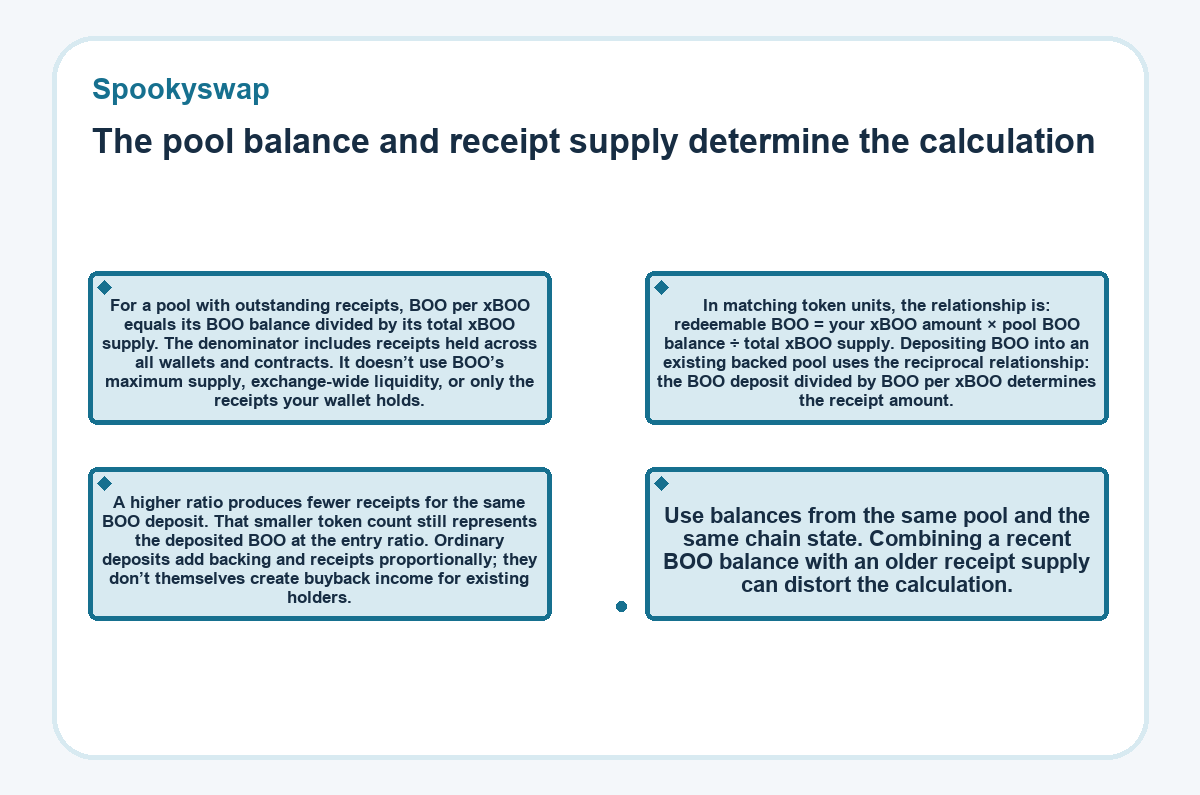
Depositing BOO into an existing backed pool uses the reciprocal relationship: the BOO deposit divided by BOO per xBOO determines the receipt amount. A higher ratio produces fewer receipts for the same BOO deposit. That smaller token count still represents the deposited BOO at the entry ratio. Ordinary deposits add backing and receipts proportionally; they don’t themselves create buyback income for existing holders.
Use balances from the same pool and the same chain state. Combining a recent BOO balance with an older receipt supply can distort the calculation.
Buybacks increase backing when BOO reaches the pool
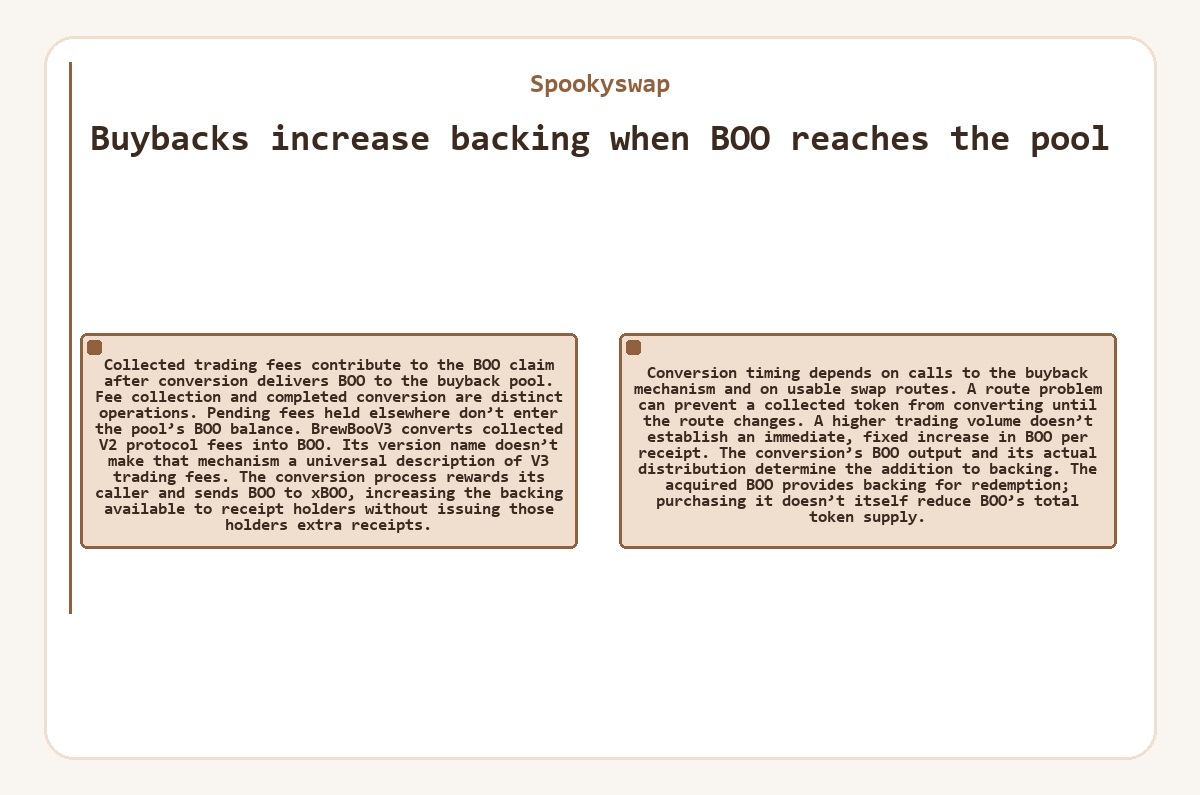
Collected trading fees contribute to the BOO claim after conversion delivers BOO to the buyback pool. Fee collection and completed conversion are distinct operations. Pending fees held elsewhere don’t enter the pool’s BOO balance. BrewBooV3 converts collected V2 protocol fees into BOO. Its version name doesn’t make that mechanism a universal description of V3 trading fees. The conversion process rewards its caller and sends BOO to xBOO, increasing the backing available to receipt holders without issuing those holders extra receipts.
Conversion timing depends on calls to the buyback mechanism and on usable swap routes. A route problem can prevent a collected token from converting until the route changes. A higher trading volume doesn’t establish an immediate, fixed increase in BOO per receipt. The conversion’s BOO output and its actual distribution determine the addition to backing. The acquired BOO provides backing for redemption; purchasing it doesn’t itself reduce BOO’s total token supply.
Wallet holdings and partner deposits show different balances
xBOO deposited in a partner single-stake pool continues participating in the underlying buyback pool. The additional pool records a deposit of receipt tokens and applies its own reward terms. Its deposited balance can remain visible in the staking interface while the wallet’s directly held xBOO decreases. Counting both locations as though each still holds the same receipts overstates the position.
| Holding | What the token count represents |
|---|---|
| BOO held directly | BOO outside the buyback pool, without an xBOO claim from that holding. |
| xBOO held directly | Receipt units whose BOO claim follows the matching buyback pool’s ratio. |
| xBOO deposited in a partner pool | Deposited receipt units retaining their underlying buyback participation. |
| Partner tokens held after harvesting | A separate reward-token balance, outside the xBOO receipt count. |
Partner rewards don’t automatically increase the BOO backing per xBOO. They belong to a separate reward program, whose asset and availability depend on the selected pool. A displayed combined staking return can therefore describe income in different tokens. Keep those quantities separate before assigning a common currency value. Single-stake xBOO deposits also differ from liquidity farming: they use receipt tokens without requiring a liquidity pair for that deposit.
Fantom and Sonic positions belong to separate deployments
An xBOO claim belongs to its network’s staking contract and the BOO token backing that contract. Fantom Opera and Sonic have separate deployments. Their identical token symbols don’t combine their pool balances or move a claim between chains. Connecting a wallet to Sonic doesn’t convert an older Fantom staking position. Each position needs its own receipt count, backing balance, and total receipt supply.
The BOO migration launched on December 26, 2024, as a one-way conversion from Fantom Opera to Sonic. Its terms specified one Sonic BOO for each Fantom BOO and a four-month migration window. Participants holding xBOO had to redeem it for BOO before migration. That BOO conversion rate didn’t set the xBOO redemption ratio. The original four-month window has elapsed. An older position’s BOO claim and eligibility for any later migration remain separate matters.
Redeemable BOO and market value answer different questions
The BOO claim measures an amount of tokens, while a currency valuation also depends on BOO’s market price. A higher BOO-per-xBOO ratio can coexist with a lower currency valuation if BOO’s price falls enough. Partner reward tokens introduce their own prices. Combining their counts directly with a BOO amount produces a total without a consistent unit.
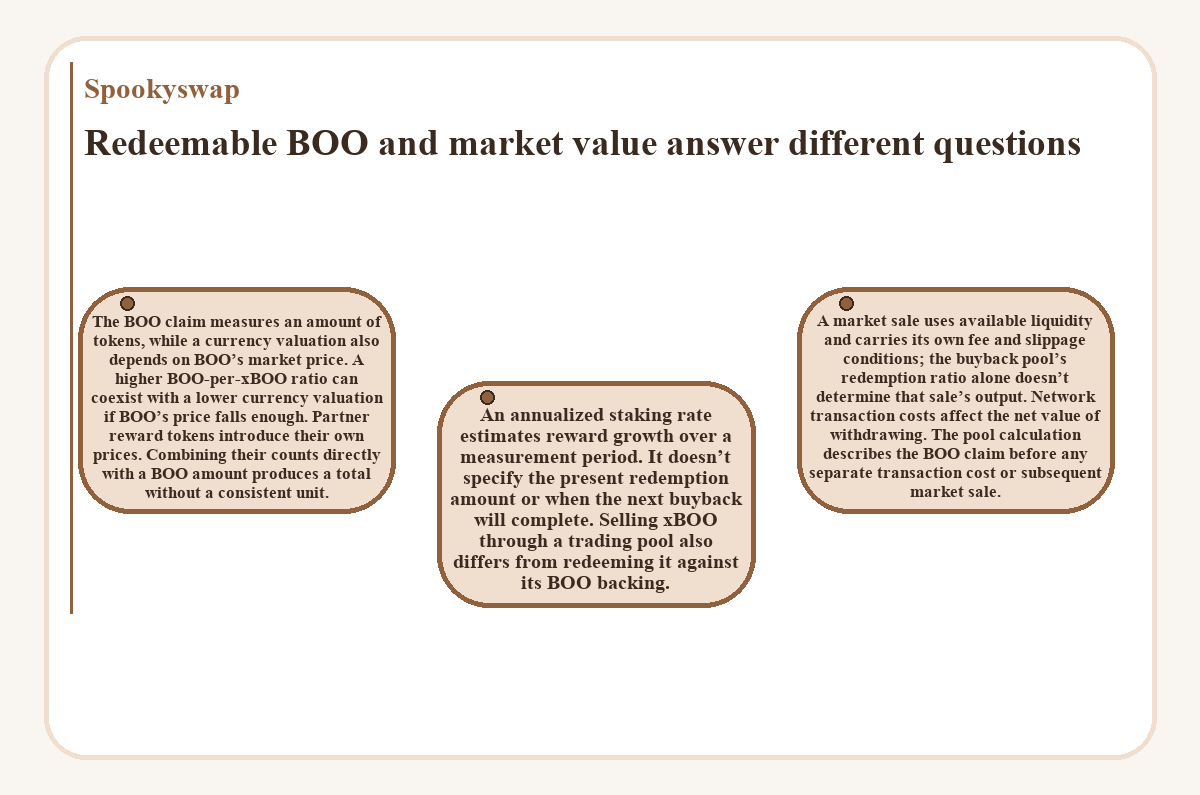
An annualized staking rate estimates reward growth over a measurement period. It doesn’t specify the present redemption amount or when the next buyback will complete. Selling xBOO through a trading pool also differs from redeeming it against its BOO backing. A market sale uses available liquidity and carries its own fee and slippage conditions; the buyback pool’s redemption ratio alone doesn’t determine that sale’s output.
Network transaction costs affect the net value of withdrawing. The pool calculation describes the BOO claim before any separate transaction cost or subsequent market sale.
Key questions about Spookyswap
-
Does approving BOO create an xBOO balance?
- Approving BOO authorizes spending within an allowance; it doesn’t deposit BOO or create xBOO. Receipt issuance belongs to the staking deposit. The Sonic xBOO contract also exposes a permit-based entry method, so a separate approval transaction isn’t a universal requirement across entry paths. Interface support determines which method you can use. An authorization alone doesn’t establish that the deposit executed.
-
Can I redeem only part of my xBOO?
- The documented buyback model allows redemption of a chosen receipt amount. Redeeming part of the balance reduces your xBOO holding and returns the corresponding BOO claim. The remaining receipts continue following the pool’s ratio. Receipts deposited in a partner pool first need to become available for redemption under that pool’s withdrawal rules.
-
How long must xBOO remain staked before redemption?
- The documented buyback pool allows xBOO redemption at any time, without a fixed staking term. Completing a withdrawal still requires the network to execute the redemption transaction. A partner pool holding your receipts can introduce its own withdrawal conditions, so the underlying buyback pool’s timing rule doesn’t establish the terms of every additional staking program.
-
Who can redeem the BOO backing after an xBOO transfer?
- The recipient controls the transferred receipts and their associated BOO claim. Redemption follows possession of xBOO, so the original depositor can’t redeem those same receipts using deposit history alone. A normal transfer doesn’t send BOO out of the buyback pool. If you intend to retain that claim, moving xBOO to another wallet moves control of it.
-
Is an unchanged displayed xBOO ratio proof that buybacks have stopped?
- An unchanged displayed ratio doesn’t establish whether buybacks have stopped. The older staking interface used periodic refreshes, so a cached display could lag changes in the contract. The actual ratio follows the pool’s BOO balance and receipt supply. It can also remain unchanged until converted BOO reaches the pool. Display timing and incomplete fee conversion are different explanations for a stationary number.